
Experimental with Amale Ghalbouni & Sean Carney on Human-Centred Transformation
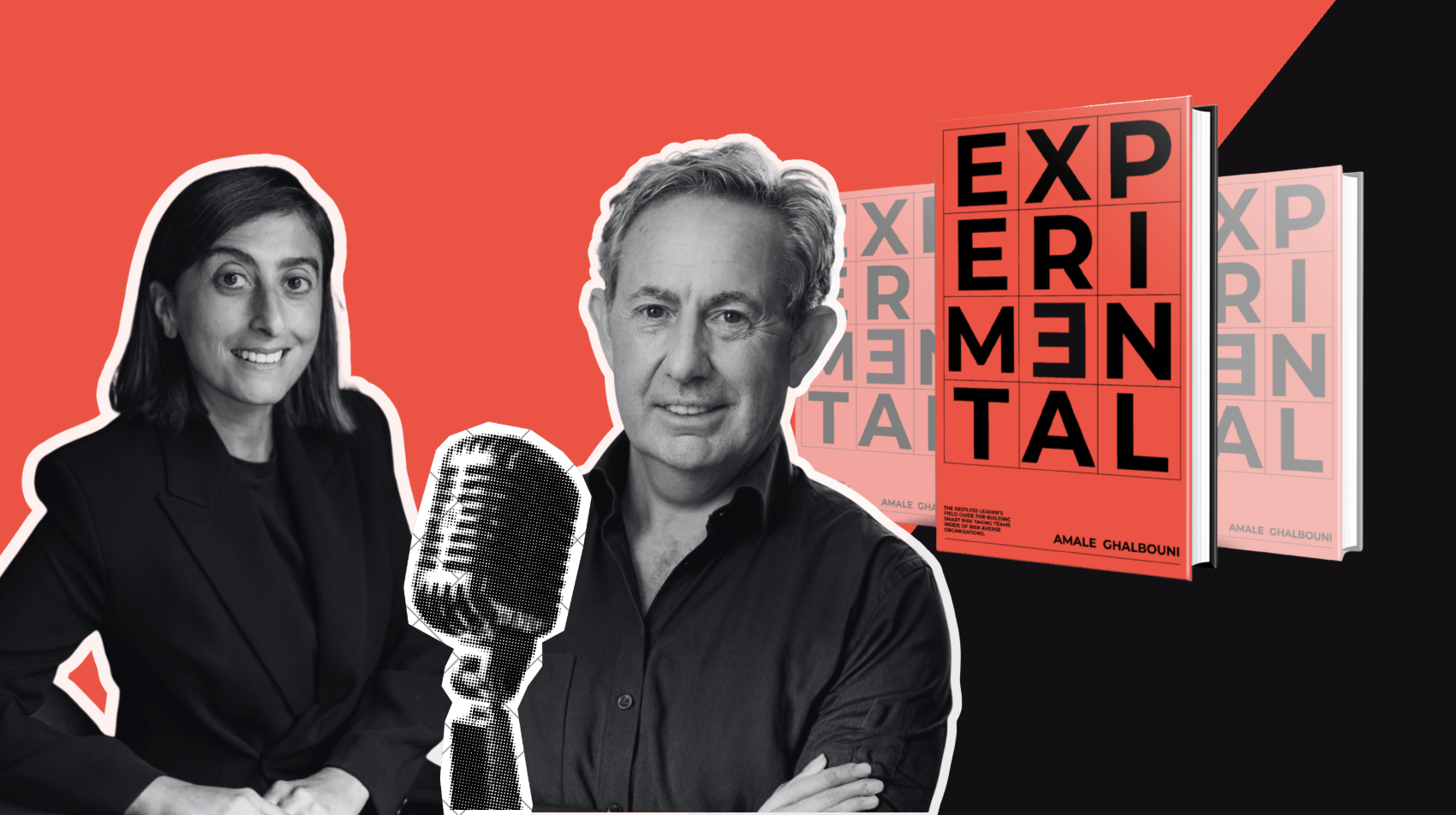
Amale Ghalbouni & Sean Carney in conversation. Excerpt taken from the conversation featured in Experimental
What connects a Lady Gaga dress, a blanket for newborn babies and the future of healthcare?
Experimentation.
Sean Carney, former Chief Design Officer and Executive Vice President at Philips, has spent more than 30 years using design to help large organisations turn emerging technology into meaningful human value.
Our conversation ranges from digital lighting and neonatal care to distributed hospitals, failed baby bottles and the risks created by AI-generated prototypes.
The common thread is simple:
Innovation works when leaders stay close to the problem, involve the full system and remain willing to change the solution.
These insights feature in my book Experimental.
From Lady Gaga to treating jaundice
Philips was developing medical sensors that could track a person’s physical state. At the same time, its lighting business was exploring the possibilities created by digital LEDs.
The design team combined the two.
They created clothing that translated physical and emotional signals into light and colour. Lady Gaga wore one of the dresses on stage.
It was an arresting demonstration of the technology.
Then came the important question:
So what?
The experiment proved what sensors and LEDs could do together. The team still needed to connect that capability to a meaningful need.
That led them to babies with jaundice.
Traditional treatment could involve separating a baby from its parents, covering its eyes and exposing its skin to high-intensity light.
Philips incorporated LEDs into a blanket.
The baby could receive therapy while being held, fed and comforted.
“Lady Gaga took us to fixing jaundice in babies,” Sean said.
The first experiment didn’t have to become the final product.
It expanded what the team knew was possible and opened a route towards a more valuable application.
Innovation needs diverse people, not only designers
Sean is clear that meaningful innovation isn’t produced by one specialist function.
“Impactful innovation only really happens when you’ve got a very diverse set of people contributing to it.”
Design can help visualise and prototype an idea, but the insight may come from a clinician, engineer, customer, finance leader or someone whose brain approaches the problem differently.
Diversity here means more than demographics.
It includes professional expertise, lived experience, age, culture, neurodiversity and different ways of interpreting the same situation.
Breakthrough ideas are less likely to emerge from a room where everyone shares the same assumptions.
Leaders need to open the process and let unexpected people influence both the question and the answer.
Radical empathy means understanding the whole system
At Philips, Sean developed a principle he called radical empathy.
It meant getting closer to the action rather than relying on research from a safe distance.
Designers spent time in operating theatres, hospitals and the real environments where the work took place.
But radical empathy went beyond understanding the patient or end user.
A healthcare innovation might improve a patient’s experience and make sense to the clinician. It could still fail because it doesn’t integrate with hospital technology, match the financial model or fit the way insurance pays for care.
Sean’s teams mapped the wider ecosystem.
Who benefits? Who pays? Who carries risk? Who needs to change their behaviour? Which system needs to connect? Who could block adoption?
Many transformations fail after hitting a system that wasn’t designed to accept them.
Radical empathy helps you spot those obstacles before the full rollout.
Ask whether you’re solving the right problem
One of Sean’s most powerful examples came from a Japanese university medical centre.
The client had funding to build a large, state-of-the-art hospital in an area affected by an earthquake and tsunami.
The project sounded impressive.
Sean’s team asked who the hospital was meant to serve.
The region had an ageing population spread across remote areas. Many people would struggle to reach a central facility.
The better question became:
Is a large hospital the right answer to the health needs of this population?
The team explored a distributed care model involving smaller clinics, mobile diagnostics and a central command centre connecting specialists across the region.
Philips worked with Toyota and SoftBank on early versions of mobile care units.
Instead of one shiny building, the solution became a connected network.
That reframing required courage. A large hospital offers politicians a visible opening and a ribbon to cut. A distributed system can produce better outcomes without the same dramatic symbol.
Human-centred innovation returns repeatedly to the problem, even when the organisation has already fallen in love with the proposed answer.
Think long term and test in the short term
Sean’s work combines long-term imagination with near-term experimentation.
A future vision might include autonomous clinical vehicles, remote monitoring and medicine delivered by drones.
That doesn’t mean launching the full system today.
Imagine what could become possible in ten years. Work backwards to what may be viable in five. Then ask what you can prototype or test in the next development cycle.
The long-term direction provides ambition.
The short-term experiments reveal which route is credible.
This is very different from using experiments as a series of disconnected quick fixes.
You’re making smaller bets in service of a much larger horizon.
Don’t fall in love with the solution
Sean shared a failed Philips experiment involving connected baby bottles.
The team added sensors to bottles to explore feeding behaviour and sleep patterns.
The concept gained significant attention and looked like a natural extension of connected technology.
Commercially, it went nowhere.
“People don’t want electronics anywhere near their baby bottles.”
The team had become excited about what the technology could do without staying close enough to the problem parents needed solved.
“Don’t fall in love with the solution. Fall in love with the problem.”
The same warning applies to AI, operating models and organisational transformation.
Once leaders become attached to a solution, they start asking how to force adoption rather than whether the answer still fits the need.
Design with people, not for them
Sean’s advice is to design with the people affected by the change.
A central team can create a polished answer and hand it over. That may be faster initially, but the people responsible for adoption haven’t shaped the thinking or identified the operational obstacles.
Sean has used lighthouse projects that bring employees from operating businesses into a central innovation team. They solve real problems together, then return to their teams with new skills and approaches.
The project creates an output and spreads capability.
That closely reflects the principle in Experimental: build a corner of the organisation where things work differently, then let the proof do the persuading.
My bestselling business book on leadership and transformation turns that principle into a practical method for leaders who can’t redesign the whole system at once.
It’s also central to my work as an innovation keynote speaker.
Before moving further with a current transformation, ask:
Are we still solving the problem, or have we fallen in love with our solution?
To unlock this conversation and all the other conversations featured in the book,
Grab your copy of Experimental now →
And if you’d like to bring these themes to your audience, get in touch or connect with me on Linkedin.