
Experimental with Amale Ghalbouni & Dr Lisa Portz on How Experimentation Reduces The Risk of Transformation
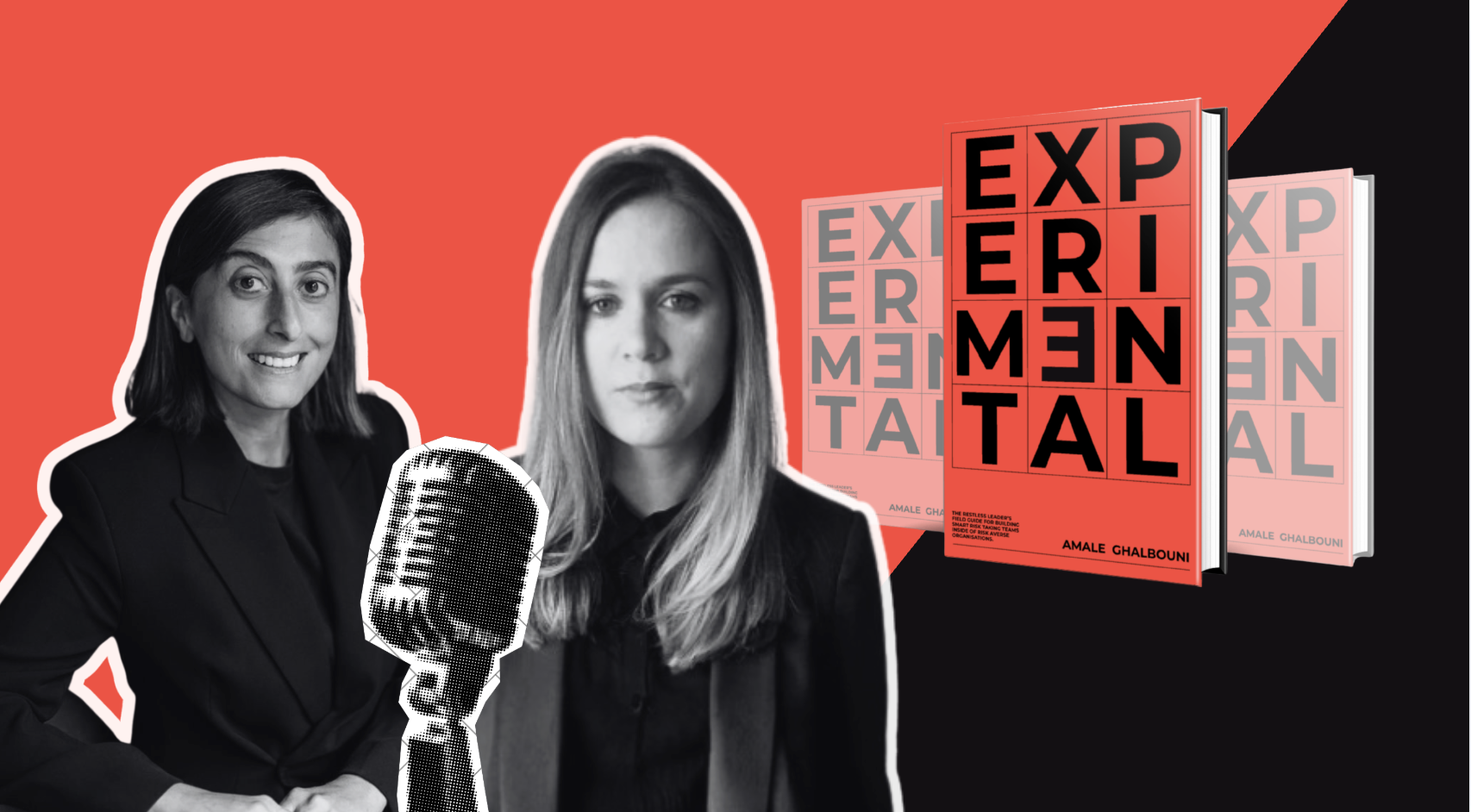
Amale Ghalbouni & Lisa Portz in conversation. Excerpt taken from the conversation featured in Experimental
Experimentation is often presented as the risky alternative to careful planning.
Dr Lisa Portz sees it differently.
“Experimentation helps de-risk business decisions.”
Lisa is an entrepreneurship lecturer at Imperial Business School and founder of Zebra Farm, where she works with start-ups, SMEs and organisations that support them.
Across those environments, she sees the same expensive pattern.
A team has an idea. It spends months developing the plan, building the product and preparing the full launch.
Then the idea meets reality, and nobody needs it.
Our conversation is about how leaders can reverse that sequence: learn first, then invest.
These insights feature in my book Experimental.
A year, a million and nothing happens
Lisa once had a founder approach her after a lean start-up session.
They told her they wished they’d heard it a year earlier.
The founder had spent a year and a million building a product. When it launched, nothing happened.
“They worked on it as if it was true.”
The tragedy wasn’t only that the product failed.
The business had spent most of its available time and money before testing whether its critical assumptions were right.
That founder could afford to try again. Many organisations can’t.
Large companies repeat the same behaviour at a different scale.
They build the business case, hire partners, create a complete change plan and launch across the organisation before discovering that customers don’t care or employees can’t use it.
Experimentation changes when the learning happens.
You test the riskiest assumption while the cost of changing direction is still manageable.
Would you prefer small failures or one big crash?
One of the biggest barriers to experimentation is psychological.
To pursue an idea, you need to believe it can work. A good experiment then asks you to seek evidence that might prove you wrong.
That isn’t comfortable.
Planning allows the idea to remain perfect. Reality might tell you the problem isn’t important, the audience doesn’t care or the solution creates another difficulty.
Lisa frames the choice clearly:
“Would you prefer a few mini failures, or one big crash?”
Small experiments create manageable moments of discomfort.
The message doesn’t land. The prototype confuses people. The customer behaves differently from the prediction.
Each result allows you to adjust.
Avoiding that discomfort until the final launch creates a much larger and more public failure.
Experimentation doesn’t eliminate failure. It changes its timing, cost and usefulness.
Move the idea out of the fantasy world
Lisa describes every early idea as living in a fantasy world.
That’s not a criticism. It simply means the idea hasn’t encountered enough evidence yet.
You may believe employees will embrace a new process. You may assume customers value a feature. You may predict that AI will improve a workflow.
Until those assumptions have been tested, they remain beliefs.
A useful experiment moves you from:
We think this will work
to:
We have enough evidence to justify the next investment
The goal isn’t perfect certainty.
It’s reducing enough uncertainty to make a better decision.
Decide by experiment rather than committee
One of Lisa’s most useful ideas is replacing some committee debates with experiments.
When nobody knows what will happen, gathering more opinions doesn’t necessarily create a better answer.
Instead of asking which senior person is right, ask:
How could we test this?
This is particularly valuable when two things are true:
The level of uncertainty is high.
The consequences of making the wrong decision are significant.
Not every decision needs an experiment. Some are governed by values, regulation or clear existing evidence.
But when a proposal has stalled because people are arguing about an outcome none of them can predict, a small test can replace opinion with information.
What makes a business experiment useful?
Lisa sees two elements missing from many experiments:
A clear deadline.
A defined threshold.
Without a deadline, the test can continue until the team finds the answer it wants.
Without a threshold, almost any result can be presented as encouraging.
“We had some interest” isn’t enough.
How much interest would justify the next investment? What result would make you stop? Which evidence would increase or reduce your confidence?
Before the test begins, define:
The assumption.
The expected outcome.
The evidence you’ll collect.
The duration.
The decision you’ll make at the end.
“Otherwise, it’s not a failed experiment,” Lisa said. “It’s just a wasted one.”
Match the experiment to the question
Not all experiments operate at the same scale.
A micro experiment might test whether a message attracts clicks or whether changing one meeting improves decision speed.
A medium-sized test might use a landing page, waitlist or prototype to examine a proposition.
A macro experiment could be a limited pilot of a wider programme.
As the experiment becomes more complex, the conclusions become less direct.
A failed landing page might reflect the proposition, audience, message or channel. A pilot involving people may be affected by leadership, timing and context.
The goal isn’t pretending every workplace test has the precision of a laboratory.
It’s gathering better evidence than you had before, then holding a retrospective to examine what the result actually means.
Culture follows goals and rituals
An organisation can say it wants experimentation while measuring only successful outcomes.
People will quickly understand which message matters.
Lisa recommends including learning and testing within the organisation’s goals.
That might mean committing to three pilots or testing five important assumptions alongside commercial targets.
The rituals matter too.
How does the organisation talk about an experiment that disproved the original belief?
Does the project disappear?
Is the person embarrassed?
Or does the team discuss what it learnt and how much unnecessary investment it avoided?
Language can help.
Lisa tends to describe an unexpected result as learning rather than failure.
“A failure is only when a start-up is done. Everything else is progress.”
Start with the end in mind.
Every decision contains a trade-off.
An organisation may claim it wants speed while creating 12 approval layers. It may say innovation matters while rewarding only predictable delivery.
Lisa brings the conversation back to one question:
What are we really optimising for?
Revenue?
Learning?
Customer value?
Risk reduction?
Employee retention?
Survival?
The answer shapes both the experiment and the definition of success.
These ideas sit at the centre of Experimental, my bestselling business book on leadership, innovation and transformation.
The book helps leaders inside complex organisations replace large, abstract change programmes with smaller actions that generate real evidence.
It’s also the foundation of my work as an innovation keynote speaker.
Start with a decision your organisation has delayed because the stakes and uncertainty are both high.
Then ask:
What’s the smallest test that could help us make this decision with more confidence?
To unlock this conversation and all the other conversations featured in the book,
Grab your copy of Experimental now →
And if you’d like to bring these themes to your audience, get in touch or connect with me on Linkedin.