
Experimental with Amale Ghalbouni & Mark Stevens on Using proof to build momentum while transforming an organisation’s culture
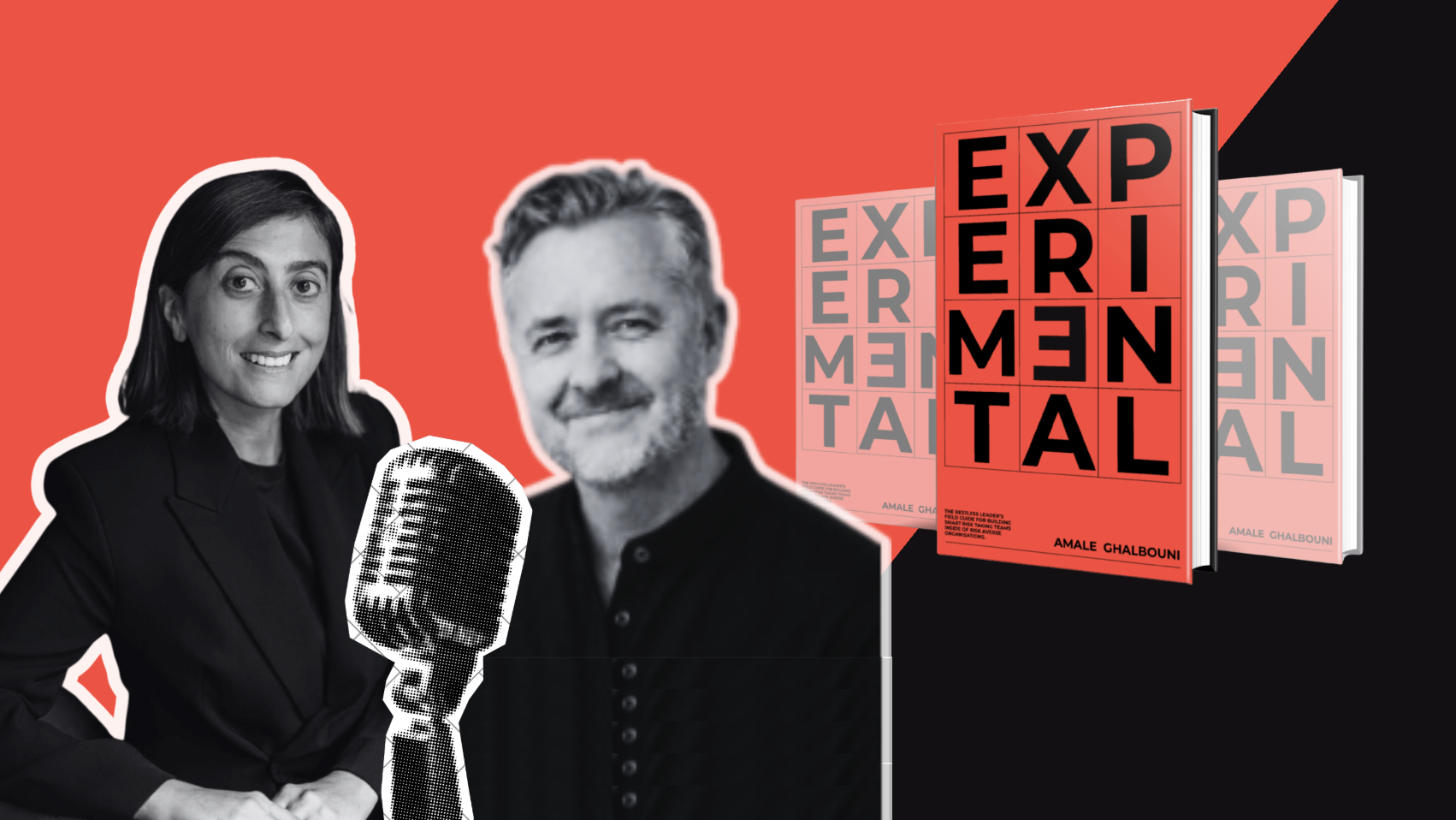
Amale Ghalbouni & Mark Stevens in conversation. Excerpt taken from the conversation featured in Experimental
Many organisations don’t lack a transformation strategy.
They lack movement.
Mark Stevens, Chief Digital and Technology Officer at C&A, has spent 25 years solving that problem across fashion, retail and technology businesses including Gap and Levi Strauss & Co.
When we spoke, Mark described his first phase at C&A as “awakening the engine”.
The opportunity was clear, but unlocking it required more than producing a vision. He needed board alignment, investment, the right people and enough early activity to prove that the strategy could become real.
“Why take two years to have a strategy when you can initiate parts of it and start mobilising?”
Our conversation explores how digital transformation leaders can create momentum before every detail is resolved, without confusing speed with recklessness.
These insights feature in my book Experimental.
Transformation starts with a problem that matters
Mark doesn’t begin with technology.
He begins with the business problem.
“What is the most impact we can make as a team, and how do we create a purpose around that?”
Digital and AI programmes can easily become disconnected from the organisation’s real needs. Leaders get excited about the tool or the size of the ambition before defining what needs to improve.
Mark listens first.
Where is the business struggling? What creates friction for the customer? Which capability is holding the organisation back? Who already cares about solving the problem?
That understanding becomes the basis of what he calls strategic storytelling.
The story connects the problem, the opportunity and the first practical move. It helps people understand why the change deserves attention.
But the story isn’t the end product.
Mark then looks for something he can bring to life.
A prototype. A benchmark. A small product. A decision that clears the way.
The aim is traction.
Proof amplifies courage
Mark’s strongest principle is simple:
“Proof amplifies courage.”
A leader can talk about the future for months. Once people can see a prototype, use an early product or examine evidence from a test, the conversation changes.
The idea feels less abstract. The perceived risk becomes more manageable. Stakeholders become more willing to back the next step.
Mark saw this repeatedly at Gap and Levi’s, where teams developed prototypes and got products into people’s hands rather than waiting for the whole long-term solution.
The first proof doesn’t need to solve everything.
It needs to answer an important question.
Will people use this? Can we deliver it? Does it create value? Will the organisation support it? Is there enough evidence to justify more investment?
You’re no longer asking people to believe a presentation.
You’re showing them what happened when the idea met reality.
That evidence gives teams and senior stakeholders more confidence to move.
Courage is a sequence, not a single leap
Earlier in his career, Mark had plenty of ambition but less confidence beneath it.
He worried about rejection, funding and whether a failed idea could damage his career.
Experience changed the way he saw courage.
“I feel it as an obligation to be courageous and ask the questions.”
For a transformation leader, avoiding the difficult issue isn’t neutral. It leaves the organisation where it is.
But courage doesn’t begin by charging into the boardroom with a radical answer.
Mark’s sequence is more grounded.
Listen. Understand the context. Build trust. Gather evidence. Find the right partner. Then make the call.
Eventually, more analysis stops reducing risk.
“It’s just one decision. I’m going to do it.”
That decision may involve asking for investment, naming a problem everyone has avoided or telling the organisation it needs to fix the foundations before launching the exciting work.
Trust creates permission to push
Mark doesn’t enter a company and immediately tell people how to change it.
“I need to listen and understand and empathise and gather data and ask questions and build trust.”
People need evidence that the leader respects what already exists and understands the realities surrounding the work.
Trust grows when you follow up on small commitments, fix genuine problems and show how the transformation connects to priorities people already care about.
Only then can you ask people to take a larger risk with you.
This closely reflects the five conditions in Experimental.
Connection and clarity come before courage. Without them, bold leadership can look like recklessness imposed by someone who hasn’t understood the system.
Governance can increase autonomy
Governance hasn’t always been Mark’s favourite concept.
His natural instinct is to act.
As the scale and consequences of his decisions have grown, he has come to value governance that is lean, clear and useful.
“It can be lean and it can be lightweight, and it’s really important.”
Good governance answers practical questions.
Who owns the decision? What evidence is required? Which risks need escalation? What can teams decide independently? How quickly should the process move?
This becomes even more important when organisations adopt AI or make technology choices that may shape their operating model for years.
Poor governance creates delay and dependence.
Clear governance can increase autonomy because teams know the boundaries within which they’re free to act.
Pushback is useful information
Mark has learnt to become curious about resistance.
“I’m a bit like a dog with a bone now. What’s behind this?”
A person saying no might be protecting a legitimate operational concern. They may have seen a previous programme fail. The timing may be wrong, the strategy unclear or the evidence incomplete.
Pushback may also be fear of change.
Those situations need different responses.
Mark tries to understand the concern, gather the missing proof or agree the conditions that would make the other person more comfortable.
That doesn’t mean waiting for complete consensus.
It means using resistance to improve the work rather than treating every objection as disloyalty.
Strategy, people and clearing the way
Mark uses a simple leadership model:
Set the strategy.
Organise and develop the people.
Clear the way.
It helps him diagnose where work has become stuck.
Is the direction unclear? Are the right capabilities missing? Or is a barrier preventing good people from delivering?
Leaders often jump to execution and push the team harder.
Mark’s model forces them to check whether the problem sits earlier in the chain.
What to do in your first 30 days
Mark’s advice for a new leader is highly practical.
Listen. Build relationships. Follow through. Find a real problem and fix it.
The problem doesn’t have to be the organisation’s largest issue.
It might be a contract spiralling out of control, a stalled decision or a process making everyone’s job harder.
The first useful proof point changes how people see you.
They learn that you listen, keep your word and create movement.
Then you can tackle something bigger.
That’s also the principle behind the 30-day loops in Experimental: The Restless Leader’s Field Guide for Building High Performing, Change Ready Teams, my bestselling business book on leadership and transformation.
Transformation doesn’t have to begin with an enormous programme. It can begin with one visible problem, one credible test and one piece of evidence that a better approach is possible.
That’s the message I bring to audiences as a transformation keynote speaker.
Start by asking:
What’s the quickest credible way to prove that a better approach could work?
To unlock this conversation and all the other conversations featured in the book,
Grab your copy of Experimental now →
And if you’d like to bring these themes to your audience, get in touch or connect with me on Linkedin.