
Experimental with Amale Ghalbouni & Paul Bennett on Design Thinking for Organisational Transformation
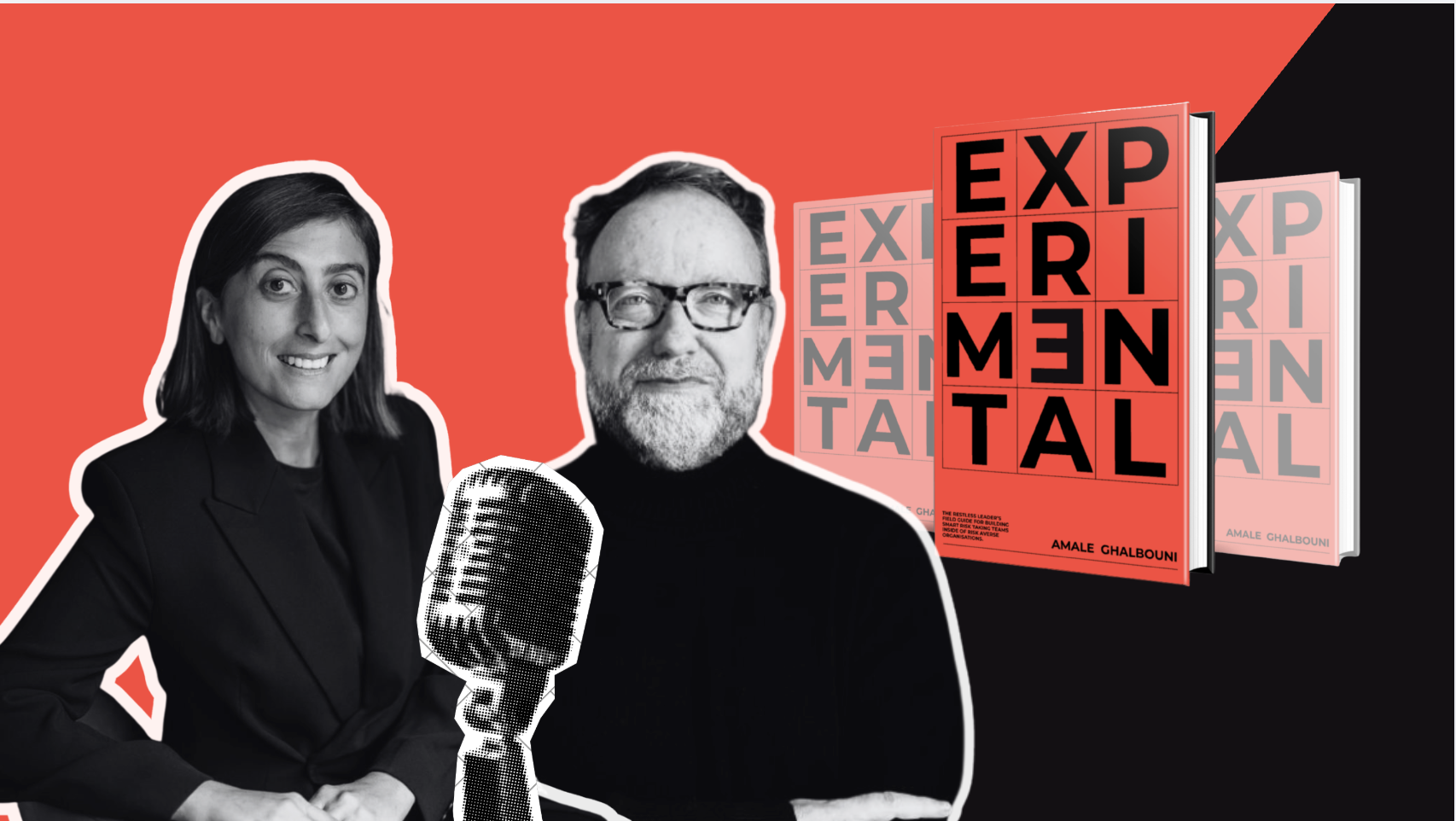
Amale Ghalbouni & Paul Bennett in conversation. Excerpt taken from the conversation featured in Experimental
Most organisations like the idea of transformation.
They’re less prepared for what being transformed actually feels like.
That distinction sits at the centre of my conversation with Paul Bennett, former co-CEO of IDEO.
Paul describes himself simply as a designer of things in the future.
He has spent his career helping organisations imagine what could exist, experience the problem more directly and make new ideas tangible enough to test.
Our conversation includes blank boardroom slides, cardboard aircraft, toilets in Ghana, emotional leadership and the people Paul calls “the grumpies”.
It’s also an honest exploration of why change feels far messier than the diagrams used to sell it.
These insights feature in my book Experimental.
Emotional leadership belongs in the boardroom
When Paul was asked to name his most useful leadership tool, he answered:
“A box of Kleenex.”
He ran IDEO as a designer and describes himself as a proudly emotional leader.
Creativity is emotional work. People become attached to ideas. They experience fear, disappointment and pride. Clients feel the same as a project begins challenging the way their organisation operates.
Paul’s strength was staying in that emotional flow and helping people move through it.
That didn’t make him less commercial.
It helped him lead a business built around ambiguity and change.
Paul was once described as bringing poetry into the boardroom.
He often uses blank slides and speaks directly from personal experience rather than filling the screen with another framework.
Data can explain the size of the opportunity. Story and emotion can make people care enough to act.
Leaders need to go first
Paul is direct about vulnerability:
“If you want people to get naked, you have to take your clothes off first.”
He has shared photographs of himself during a cardiac emergency. He has emptied the medication, syringes and health equipment from his bag onto a table when working with healthcare businesses.
He makes the customer real by showing that he is one.
Leaders regularly ask why employees don’t admit mistakes, challenge decisions or share unfinished ideas.
Paul’s answer is to examine what the leader has modelled.
When did they last say they were wrong? Share something unfinished? Ask for help? Let the team see the person beneath the role?
Nobody wants to go first when the consequences of vulnerability are unclear.
The leader creates the first piece of evidence that it’s safe.
The mythology and reality of change
“The mythology of change and the reality of change are very different.”
The mythology involves colourful notes, clean frameworks and a team moving smoothly from one phase to the next.
The reality involves confusion, conflict, changing power and moments where the project appears to be going backwards.
Paul compares the work to running with scissors and hoping nobody loses an eye.
He became critical of design thinking diagrams that made transformation look too linear.
The diagram may be tidy. The human experience isn’t.
Paul asks clients at the beginning:
How brave are you feeling?
He is listening to how they answer.
A credible response usually contains some uncertainty. The team understands that the work may expose uncomfortable truths.
Bravery isn’t feeling enthusiastic throughout. It’s remaining engaged after the novelty has disappeared and the transformation starts touching status, identity and familiar ways of working.
Bring the grumpies into the work
Paul calls internal sceptics “the grumpies”.
They may work in procurement, finance, operations or another team responsible for risk.
The instinct is often to keep them away until the project has enough proof.
Paul frequently brings them in early.
“We need you to be in it rather than on the outside throwing stones at it.”
Sceptics may see a genuine obstacle the project team has missed. They can also become powerful supporters once they understand the work and feel some ownership over it.
That doesn’t mean allowing one negative voice to dominate.
It means converting resistance into useful information.
What are they worried about? What failed before? What evidence would increase their confidence? Which guardrail does the organisation need?
Sit on the toilet of the experience
Paul believes first-hand experience creates bravery.
During a project about the future of paper and wiping, the team visited toilets around the world.
They experienced advanced Japanese toilets and a shared village toilet outside Accra in Ghana.
The team didn’t want to enter the latter.
Paul insisted they sit inside and experience the smell, discomfort and their own emotional response.
“The toilet of your project is what you’re going to be sitting on.”
When the team returned, they didn’t speak only about what the research showed.
They could say:
I saw.
I experienced.
I felt.
I wanted to act.
The problem moved from abstract data to something personally understood.
This is particularly valuable inside organisations where leaders at headquarters and employees on the ground live in completely different realities.
Sometimes the first transformation step is getting them to sit on each other’s metaphorical toilets.
Make the idea tangible
Paul is a passionate advocate of prototyping.
“Never underestimate the value of cardboard.”
IDEO built full aircraft cabins, operating theatres, cars and surgical tools using rough materials.
A physical model allowed people to understand what the idea might feel like in a way a presentation couldn’t.
A rough prototype also invites criticism.
It’s clearly unfinished, so people feel permission to improve it.
AI now makes it possible to create glossy concepts in seconds. That speed can become a trap.
Polished work looks decided. Stakeholders become less willing to challenge it, and the person who created it becomes more defensive.
For organisational transformation, a prototype might be a new meeting tested for four weeks, a draft decision process, a simulated operating model or one temporary cross-functional team.
Stop debating the abstract answer.
Make enough of it real to discover what you’ve missed.
Poetry still needs mathematics
Paul doesn’t argue for emotion instead of commercial rigour.
He describes working beside a McKinsey analyst while he explored ideas visually and she built the business model.
One created desire. The other tested viability.
The best transformation work needs both.
A compelling human idea without a credible model may never be funded.
A strong business case without a meaningful human experience may never be adopted.
Create post-ego teams
At IDEO, Paul looked for “post-ego” people.
They elevated other people rather than claiming every success.
Experimental teams need people who can listen, build on another idea, change their mind and share credit.
No one person holds the whole answer.
This is a recurring theme in Experimental, my bestselling business book on leadership and transformation.
Change becomes possible when leaders shape an environment where people can experience the problem, test something real and learn without defending their status.
It’s also central to my work as an innovation and transformation keynote speaker.
Ask:
What could we make, test or experience that would turn this change from an abstract idea into something real?
To unlock this conversation and all the other conversations featured in the book,
Grab your copy of Experimental now →
And if you’d like to bring these themes to your audience, get in touch or connect with me on Linkedin.